LatestThe Secret Zero Problem: The First Credential Attackers Target
Resource / Online Journal
Digital Twin Meaning and Examples: A Guide for Business Leaders
Discover the diverse applications of digital twin technology across industries and learn how it enhances efficiency and innovation.
Published on Aug 28, 2026

What if you could test a major business decision before making it in the real world?
Whether it's increasing production capacity, redesigning a supply chain, or optimizing facility operations, leaders are constantly balancing risk, cost, and performance. This is where digital twin technology is gaining attention.
A digital twin gives organizations a dynamic virtual representation of physical assets, processes, systems, or even entire operations. By combining real-world data with analytics and simulations, leaders can evaluate potential outcomes, identify risks earlier, and make more informed decisions. As digital transformation initiatives mature, digital twinning is increasingly becoming a strategic capability rather than just a technological innovation.
What Is a Digital Twin?
To understand the digital twins meaning, think of a digital twin as a living digital counterpart of something that exists in the real world.
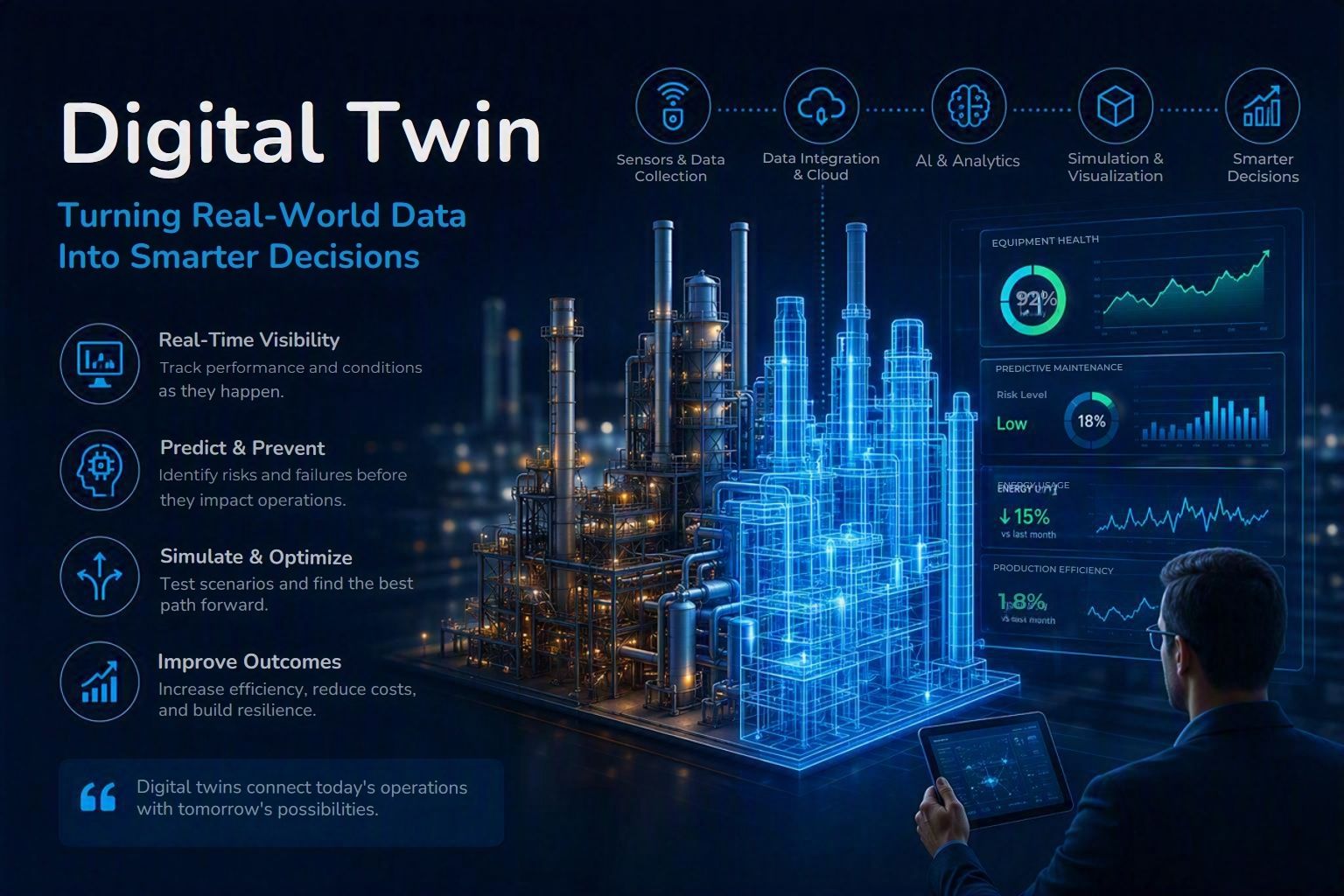
Unlike a static 3D model, a digital twin continuously receives data and reflects current conditions, performance trends, and operational changes. It can also simulate different scenarios, helping organizations evaluate decisions before taking action.
Three main elements usually make up a digital twin:
- A physical asset, process, or system
- A virtual model representing it
- A continuous flow of operational data connecting the two
In simple terms, digital twin is a virtual representation connected to real-time data that helps organizations monitor, analyze, and optimize operations.
For example, a manufacturing company may create a digital twin of an entire factory. The model can combine machine telemetry, maintenance records, production schedules, and energy usage data. Before changing production plans, leadership teams can evaluate potential outcomes in the digital environment, reducing uncertainty and improving planning accuracy.
How Does Digital Twin Technology Work?
At a high level, digital twin technology follows a continuous feedback loop:
Sensors, applications, machine logs, and business systems collect data.
- The data updates the virtual model in near real time.
- Analytics and AI identify patterns, inefficiencies, or risks.
- Leaders simulate different decisions and compare outcomes.
Operational changes generate new data, continuously improving the model. The underlying technology may include IoT devices, cloud platforms, data integration tools, artificial intelligence, simulation engines, and visualization technologies. While the technology behind digital twins can be sophisticated, the business objective remains simple: transform operational data into actionable insights.
Why Leadership Teams Are Investing in Digital Twinning
Most executives are not interested in technology for its own sake. They want better business outcomes. The growing interest in digital twinning comes from its ability to provide a clearer understanding of operations and support more confident decision-making. Common leadership benefits include:
- Improved visibility into complex operations
- Earlier detection of potential failures and disruptions
- Better scenario planning and risk assessment
- Enhanced operational efficiency
- Stronger business resilience
- More informed strategic decisions
Rather than relying solely on historical reporting, leaders can explore how future decisions may affect performance before implementing changes.
This ability to evaluate "what-if" scenarios is one of the key benefits of digital twins, particularly in industries where operational downtime or poor decisions can be costly.
Digital Twin Meaning and Examples Across Industries
The value of a digital twin becomes easier to understand when viewed through practical business applications.
Manufacturing
Manufacturers use digital twins to monitor equipment health, support predictive maintenance, and optimize production schedules. Instead of responding to machine failures after they occur, leaders can identify warning signs earlier and reduce operational disruptions.
Buildings and Facilities
Property managers and facility operators use digital twins to monitor energy consumption, track equipment performance, and improve space utilization. A digital twin can help organizations evaluate how changes in occupancy, maintenance schedules, or resource allocation might affect costs and performance.
Supply Chains
Supply chain disruptions have become a boardroom concern across many industries. Digital twins can model suppliers, inventory levels, transportation routes, and logistics networks to help organizations evaluate the potential impact of disruptions before they occur.
Insurance and Risk Management
Insurance providers can use digital twins to model factories, buildings, fleets, and infrastructure assets. This provides greater insight into risk exposure, supports loss prevention efforts, and improves claims analysis.
Enterprise Operations
Perhaps the most strategic application is creating a digital twin of the organization itself. By connecting people, processes, systems, controls, and operational data, organizations can gain visibility into how different parts of the business interact. Leaders can assess how operational changes in one area may affect performance elsewhere, creating a more holistic view of decision-making.
What Leaders Should Consider Before Implementing Digital Twins
While the opportunities are significant, successful adoption depends on more than selecting the right platform. Before investing in a digital twin initiative, leadership teams should consider the following:
- Define a specific business problem before selecting technology.
- Confirm the availability of reliable and timely data.
- Establish ownership across business, IT, operations, and security teams.
- Protect operational, customer, employee, and sensor data.
- Validate digital models against real-world data regularly.
- Define measurable success metrics, such as downtime reduction, forecast accuracy, response times, or energy efficiency.
- Plan for integration with existing enterprise systems.
- Maintain human oversight for high-impact decisions.
- Start with a focused pilot rather than attempting an enterprise-wide rollout immediately.
Organizations that begin with a clearly defined use case are often better positioned to demonstrate measurable value and scale successfully.
The Future of Digital Twin Applications
As artificial intelligence continues to evolve, digital twins are becoming more intelligent and predictive. Future applications are expected to leverage:
- AI-driven recommendations
- Advanced predictive analytics
- Autonomous operational optimization
- Smart city management
- Connected enterprise ecosystems
Rather than simply showing what is happening today, future digital twins may increasingly suggest actions, automate responses, and continuously learn from operational outcomes. For leadership teams, this creates opportunities to improve agility, resilience, and strategic planning in increasingly complex business environments.
Final Thoughts
The digital twin is no longer limited to engineering teams and industrial environments. Today, organizations are using digital twin technology to gain deeper operational visibility, evaluate strategic decisions, and improve business performance.
Whether applied to manufacturing, facilities, supply chains, risk management, or enterprise operations, digital twins help leaders move from reactive decision-making to a more predictive and data-driven approach. As digital transformation continues, organizations that effectively combine data, analytics, and digital twinning may gain a significant advantage in understanding and optimizing how their businesses operate.
The organizations that gain the most from digital twinning will be those that combine data, intelligence, security, and governance to make better decisions, without losing sight of human oversight and accountability.
Exploring how digital twins can support your organization’s next transformation initiative? Connect with one of the top cybersecurity firms TechDemocracy to explore how digital transformation, identity, security, and governance can work together to build a more resilient digital enterprise.
FAQs
What is a digital twin in simple terms?
A digital twin is a live digital model of a real-world asset, process, or system that uses operational data to monitor conditions and evaluate potential actions.
What is digital twinning?
Digital twinning is the process of creating, maintaining, and continuously updating a digital twin throughout the lifecycle of an asset, process, or organization.
What is the difference between a digital twin and a simulation?
A simulation models possible scenarios or outcomes. A digital twin remains connected to its real-world counterpart and continuously receives updated operational data.
Is a digital twin the same as a three-dimensional model?
No. A 3D model primarily represents appearance or structure. A digital twin also reflects performance, behavior, and operational conditions through connected data.
What are common digital twin examples?
Common examples include factory equipment twins, building twins, vehicle twins, supply chain twins, infrastructure twins, and digital twins of business processes.
What are the benefits of digital twins?
The benefits of digital twins include better operational visibility, earlier problem detection, improved forecasting, scenario testing, stronger risk management, and more informed decision-making.
Can a business have a digital twin of its operations?
Yes. Organizations can create digital twins of processes, supply chains, facilities, or broader enterprise operations to understand performance and evaluate strategic changes before implementation.
What are the risks of digital twin technology?
Key risks include poor data quality, inaccurate models, cybersecurity vulnerabilities, privacy concerns, integration challenges, unclear ownership, and overreliance on automated recommendations without human oversight.
Recommended articles


Best IAM Solutions Provider: An In-Depth Exploration of Top Identity and Access Management Services
Take Your Identity Strategy
to the Next Level
Strengthen your organization's digital identity for a secure and worry-free tomorrow. Kickstart the journey with a complimentary consultation to explore personalized solutions.