LatestThe Secret Zero Problem: The First Credential Attackers Target
Resource / Online Journal
Endpoint Security: A Practical Guide to Protection
Learn how to secure your endpoints effectively with practical strategies and best practices. Enhance your cybersecurity measures today.
Published on Sep 23, 2026
Identity Governance & Administration

Modern business depends on a distributed network of devices, making endpoints the primary target for cybercriminals. This guide provides security professionals and IT administrators with a practical framework for deploying, managing, and optimizing enterprise endpoint protection. You will learn how to design a defense-in-depth architecture, select the right software solutions, and implement operational practices to secure your organization's infrastructure.
Why Endpoint Security Is Important
An endpoint breach can disrupt operations, cause massive financial losses, and damage your brand's reputation. When an attacker compromises a single workstation, they can lateral across the network, steal sensitive intellectual property, and access regulated customer data. This often results in hefty regulatory fines, costly legal battles, and expensive remediation services.
Remote and hybrid work models mean employees connect to corporate assets from home networks, public Wi-Fi, and personal devices. Because firewalls can no longer isolate and protect these assets, the endpoint itself must serve as the primary line of defense.
How Endpoint Security Works
Endpoint security software relies on continuous telemetry collection. Lightweight software agents installed on workstations, servers, and mobile devices track system activity in real time. This telemetry includes:
- Process executions and command-line arguments.
- Registry modifications and system configuration changes.
- Network connections established by local applications.
- File creations, mutations, and deletion events.
Detection and Response Lifecycle: The endpoint detection and response lifecycle operates in a continuous loop to minimize attacker dwell time:
[Collect Telemetry] ➔ [Analyze Behavior] ➔ [Detect Anomaly] ➔ [Trigger Alert] ➔ [Investigate & Respond]
- Collection: Agents aggregate raw behavioral data.
- Analysis: Detection engines compare telemetry against known threat indicators and behavioral baselines.
- Identification: The system flags suspicious activity, such as an unknown process attempting to dump memory.
- Triage: Security analysts review the alert context to confirm whether the threat is genuine or a false positive.
- Remediation: The security team neutralizes the threat and cleans the affected system.
To stop fast-moving threats like ransomware, endpoint platforms trigger automated containment actions before an analyst can manually intervene. The agent can automatically isolate the host from the network, terminate malicious processes, quarantine infected files, or revoke compromised user sessions.
Common Cyber Threats Targeting Endpoints
- Attackers deploy diverse malware strains tailored to bypass basic detection engines.
- Ransomware is one of the most destructive threats an enterprise can face.
- Phishing remains the most common entry point for endpoint compromises.
Learn Top 10 types of Endpoint security threats every organization should know here...
Endpoint Security Components
An enterprise endpoint security platform combines four core disciplines:
- Prevention: Strengthens security controls and mitigates known threats through predefined rules and policies.
- Detection: Identifies zero-day exploits, living-off-the-land techniques, and active adversaries.
- Response: Enables rapid containment, process termination, and remediation to minimize the impact of security incidents.
- Management: Centralizes policy enforcement, configuration deployment, and health monitoring.
Agent and Console Architecture
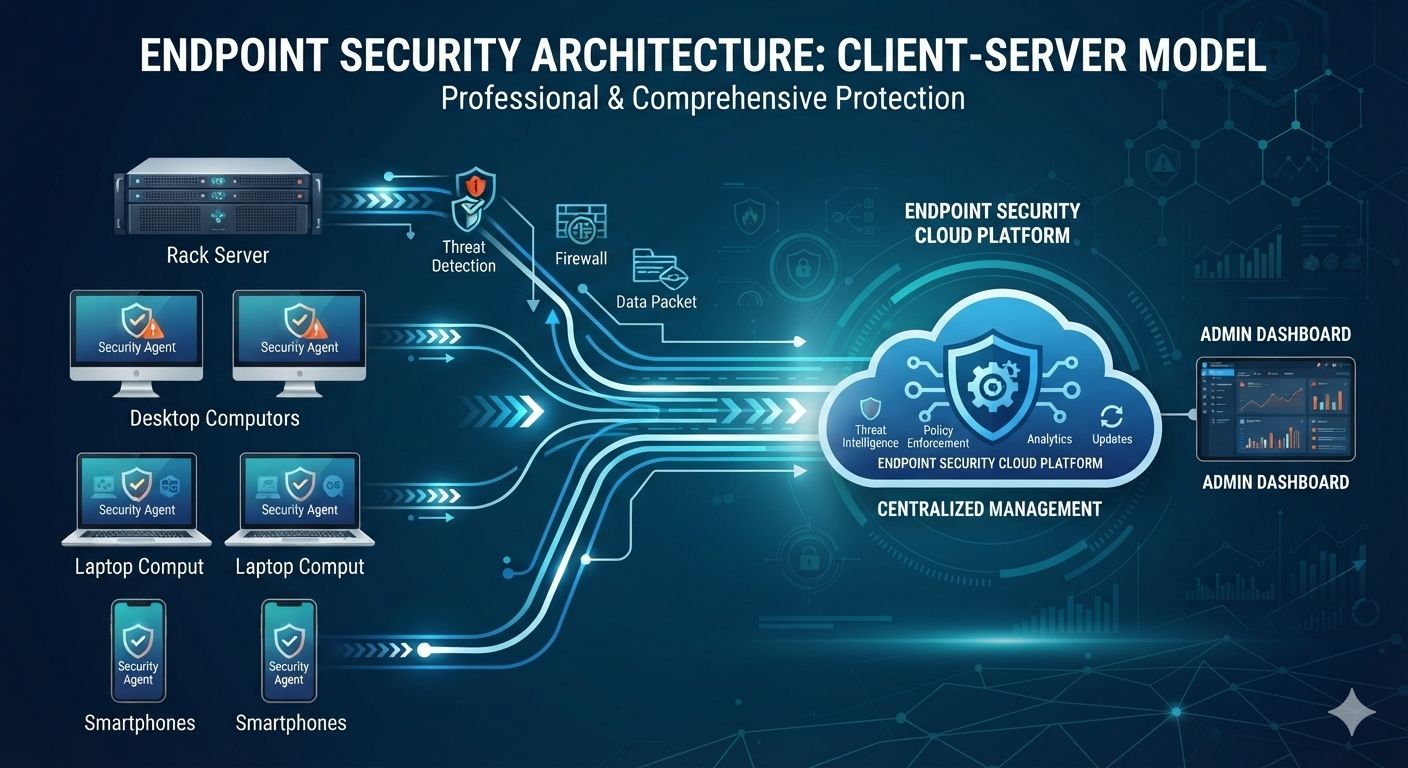
Enterprise solutions utilize a client-server architecture. A low-overhead agent runs on each local machine, enforcing policies and collecting data. This agent communicates with a centralized management console, typically hosted in the cloud, where administrators configure security rules, view alerts, and manage deployments.
Centralized Logging and Reporting
Security agents must stream their event logs to a centralized repository, such as a Security Information and Event Management (SIEM) or Extended Detection and Response (XDR) platform. Centralized logging ensures that even if an attacker destroys an endpoint, a permanent, tamper-proof record of their activity remains available for forensic analysis.
Compliance Mapping
Implementing structured endpoint controls helps organizations fulfill strict regulatory requirements:
| Compliance Standard | Required Endpoint Control |
|---|---|
| PCI DSS | Antivirus deployment, file integrity monitoring, and regular patching. |
| HIPAA | Full-disk encryption and strict access controls for health data. |
| GDPR | Continuous monitoring, rapid breach notification, and data loss prevention. |
Endpoint Device Protection
Antivirus vs. Next-Generation Antivirus (NGAV): Traditional antivirus relies entirely on static signatures, making it blind to new, modified, or fileless malware variants. Next-Generation Antivirus (NGAV) goes beyond signatures, using machine learning, behavioral analysis, and exploit mitigation techniques to identify and block threats based on their actions, rather than their file hashes.
Securing physical and virtual endpoints requires a disciplined hardening routine:
- Disable unused hardware ports (such as USB or Thunderbolt) to prevent physical data exfiltration or rogue device attachment.
- Turn off unnecessary OS services and protocols (like SMBv1) to shrink the device's attack surface.
- Enforce local firewall policies to block unauthorized inbound and outbound connections.
- Remove local administrative rights from standard user accounts to prevent unauthorized software installations.
Network Security Controls
Network segmentation stops attackers from moving freely through your environment if they compromise a single device. Isolate your endpoint fleets into distinct, logical zones based on function or department (e.g., HR, Finance, Engineering). Workstations should never be able to communicate directly with one another over the local network.
Network Access Control (NAC): Validates device posture before granting network access. If a device lacks an active security agent or misses critical security updates, the NAC quarantines it automatically.
Virtual Private Networks (VPNs): Mandate always-on VPNs or Zero Trust Network Access (ZTNA) clients for remote workers. This ensures all corporate traffic is encrypted and routed through security inspection points, regardless of location.
Application Control
Application whitelisting (or application control) establishes a strict trust model where only explicitly approved applications are allowed to run. Administrators create rules based on file paths, cryptographic hashes, or trusted digital signatures. Any unauthorized binary, script, or installer is blocked automatically, neutralizing unknown malware before it can execute.
When users must interact with unverified files or external software, force those applications to run inside an isolated sandbox. A sandbox restricts the application's access to the underlying operating system, local files, and network shares, ensuring any malicious behavior is safely contained.
Data Control
Protecting data at rest and in transit prevents unauthorized access if a device is lost, stolen, or intercepted:
Disk Encryption: Enforce full-disk encryption (e.g., BitLocker or FileVault) on all corporate laptops to protect data from physical theft.
Transit Encryption: Require Transport Layer Security (TLS) for all application traffic to protect data moving across untrusted public networks.
Data Loss Prevention (DLP) Enforcement
- Data Loss Prevention (DLP) solutions monitor and control data flows based on content inspection and classification rules. Configure your DLP agents at these key endpoint inspection points:
- Removable Storage: Block or restrict the copying of confidential files to external USB drives.
- Cloud Uploads: Prevent users from dropping sensitive corporate data into personal cloud storage accounts or webmail.
- Print and Clipboard: Restrict the printing or copying of highly classified text.
Browser Protection
The web browser is a primary gateway for corporate security risks. Implement centralized web filtering to block access to high-risk categories, such as gambling, piracy, newly registered domains, and known malicious sites. This significantly reduces exposure to drive-by downloads and phishing campaigns.
Deploy browser protection extensions or integrated endpoint controls that inspect file downloads in real time. These tools check file reputations, run downloads through cloud-based analysis engines, and block hazardous file types (such as .exe, .scr, or .lnk scripts) from executing out of the browser's download directory.
Endpoint Security Software and Solutions
Small and Medium Businesses (SMBs): Benefit most from all-in-one, cloud-managed Endpoint Protection Platforms (EPP) that require minimal dedicated security staff.
Large Enterprises: Require sophisticated Endpoint Detection and Response (EDR) or XDR platforms backed by a 24x7 Security Operations Center (SOC) to hunt for advanced threats.
Cloud-Native Deployment: Offers instant scalability, painless off-network management, and seamless updates. It reduces infrastructure overhead but relies on continuous internet connectivity for real-time cloud lookups.
On-Premises Deployment: Keeps all telemetry data inside your own data centers, meeting strict regulatory isolation needs. However, it demands significant maintenance, hardware investments, and complex architecture to manage remote workers.
Look for per-user or per-device subscription models that scale dynamically with your workforce. Ensure the solution's management plane can handle sudden onboarding surges without performance degradation and verify that license tiers include essential features like forensic data retention and API access.
Endpoint Protection Platform (EPP)
An EPP acts as your initial defensive barrier. Its primary goal is to scan, identify, and block known threats at the earliest stage of an attack, stopping malware from executing and saving system resources for deeper analysis.
Signature Scanning: Matches file hashes against a local database of known malicious files for rapid identification.
Heuristic Scanning: Evaluates file structures and code characteristics to detect variations of older threats without needing an exact signature match.
Deploy an EPP as your foundational security layer across every device in your inventory. By filtering out the vast majority of commodity malware, an EPP lets your security team focus their time and advanced tools on sophisticated, targeted threats.
Endpoint Detection and Response (EDR)
When a threat bypasses your EPP defenses, EDR provides the visibility needed to catch it. EDR continuously records system behavior, giving security analysts a detailed, chronological record of events to help them investigate and understand active attacks.
EDR relies on behavioral analytics to flag anomalies instead of relying on file names or hashes. For instance, if a standard utility like Excel suddenly launches a command prompt to download an external file, the behavioral engine flags it as suspicious, detecting zero-day exploits and living-off-the-land attacks in real time.
Integrate your EDR alerts directly with your security team's triage playbooks. These playbooks provide clear, step-by-step instructions for analyzing alerts, identifying false positives, and taking standard containment actions, ensuring consistent and fast incident handling.
Threat Intelligence and Continuous Monitoring
Enrich your endpoint defenses by connecting external threat intelligence feeds directly to your security tools. This automatically pulls in up-to-date indicators of compromise (IOCs), like malicious IP addresses, domain names, and file hashes discovered globally.
Move beyond threat intelligence collection by translating actionable intelligence into active defense measures. Automatically convert incoming threat feeds into customized blocking rules and behavioral alerts across your endpoint environment, helping strengthen defenses against emerging threats within minutes of detection.
24x7 Aggregation: Cyberattacks happen at all hours. Ensure endpoint telemetry streams continuously to a centralized monitoring system where automated analysis runs around the clock.
Tiered Triage Playbooks: Categorize incoming alerts by severity (low, medium, high, or critical) so your operations team can prioritize and respond to high-severity threats first.
Ensure your management console distributes new IOCs to all endpoint agents instantly. Fast distribution ensures that when a threat is identified on a single workstation, every other device in the organization is immediately updated to recognize and block that threat.
Security Policies and Proactive Protection
Least-Privilege Access Policies: Enforce the principle of least privilege (PLoP) across your entire infrastructure. Users should be granted only the minimum essential privileges and access rights required to fulfill their specific job repositorium functions. Lock down administrative privileges tightly to prevent users and any malware they accidentally run from modifying system files or changing core security settings.
Automated Patch Management: Unpatched software is one of the easiest ways for attackers to compromise systems. Implement an automated patch management policy to test and deploy security updates quickly. Prioritize high-risk vulnerabilities on operating systems, web browsers, and common runtime environments.
Multi-Factor Authentication (MFA): Mandate MFA for all endpoint logins, console access, and corporate service connections. Requiring a secondary verification factor such as a hardware key or a time-based authenticator app token stops attackers from gaining access even if they have stolen a user's password.
Security Awareness Training: Technology alone cannot stop every attack; your users are an essential layer of your defense. Run regular security awareness training and phishing simulations to help employees spot deceptive emails, avoid dangerous links, and report suspicious activity quickly.
Selecting and Deploying Endpoint Security Solutions
Pilot Testing Strategy
Before rolling out a new endpoint solution across your entire company, run a pilot test with a diverse, representative sample of devices. Include machines from different departments, operating systems, and user profiles to find software conflicts and performance issues early.
Evaluation Metrics
Track these key performance indicators (KPIs) during your pilot to measure success:
- Mean Time to Detect (MTTD): How quickly the solution flags a malicious action.
- Resource Consumption: The agent’s average and peak CPU, memory, and disk impact.
- False-Positive Rate: The frequency of legitimate applications triggering security alerts.
Security Stack Integration
An endpoint solution should not operate in an isolated silo. Confirm that the platform integrates smoothly with your existing security infrastructure, including your SIEM, identity providers, and network access controls, via standard APIs.
Operational Practices: Incident Response and Continuous Improvement
Create a dedicated incident response playbook focused on endpoint compromises. This document must clearly outline roles, responsibilities, and step-by-step procedures for every stage of an incident:
[Identification] ➔ [Isolation & Containment] ➔ [Eradication] ➔ [Recovery]
Tabletop Exercises: Run regular discussion-based simulations with key stakeholders to review security playbooks and ensure team communication is smooth during a real crisis.
Red-Team Exercises: Hire external professionals to simulate real-world attacks against your infrastructure, helping you test your security controls and validation processes under realistic conditions.
Post-Incident Root-Cause Reviews: After resolving a security incident, conduct a thorough root-cause analysis. Identify how the attacker gained access, determine why existing controls did not prevent the breach, and use these insights to update your defenses and prevent similar incidents.
Checklist: Quick Actions for Securing Endpoints
- Inventory Assets: Maintain a live inventory of all hardware, operating systems, and applications across your network.
- Deploy Foundations: Install an EPP agent on every managed device to block commodity malware.
- Enable EDR: Turn on continuous EDR telemetry collection and centralize logs for real-time visibility.
- Enforce Baselines: Require full-disk encryption, enable automated patching, and mandate MFA for all user logins.
- Pilot Metrics to Track Success: To confirm your deployment is working effectively, closely monitor your agent coverage percentage, average remediation times, and user helpdesk ticket volume related to system performance during the rollout phase.
Conclusion
Endpoint security is not limited to deploying antivirus software. As organizations operate across distributed, cloud-connected, and hybrid environments, effective endpoint protection requires a coordinated approach to prevention, detection, response, and centralized management.
A resilient endpoint security strategy combines foundational controls such as EPP, patching, MFA, encryption, and least-privilege access with EDR, continuous monitoring, threat intelligence, and well-defined incident response processes. Just as importantly, organizations should regularly test their controls, measure performance, and use lessons from incidents to continuously strengthen their defenses.
For organizations looking to build a stronger and more integrated cybersecurity strategy, TechDemocracy, a top cybersecurity firm, helps enterprises address complex security and identity challenges with solutions designed around evolving business and threat landscapes. By combining the right technologies with effective security processes and governance, organizations can strengthen endpoint resilience while maintaining the visibility and control needed to protect their digital environment.
FAQs
What is the difference between EPP and EDR?
Endpoint Protection Platforms (EPP) focus entirely on prevention. They act as your first line of defense, scanning files for signatures and heuristics to block known malware before it runs. Endpoint Detection and Response (EDR) focuses on visibility and hunting. EDR continuously monitors system behavior to detect, isolate, and investigate sophisticated threats or zero-day exploits that successfully sneak past your EPP defenses.
Why is traditional antivirus no longer enough for enterprise security?
Traditional antivirus relies heavily on static file signatures. Modern cybercriminals easily bypass these controls using fileless malware (which runs directly in a system's memory without saving a file to the disk), polymorphic code changes, and living-off-the-land techniques that abuse legitimate administrative tools like PowerShell.
How does endpoint security protect remote and hybrid workers?
Because remote workers frequently bypass corporate firewalls by connecting through home or public Wi-Fi networks, the traditional corporate perimeter is gone. Endpoint security moves protection directly onto the device itself. Using features like always-on VPNs, Zero Trust Network Access (ZTNA), and cloud-managed agents, devices remain monitored and secure no matter where they connect.
What is automated containment, and how does it prevent data breaches?
Automated containment allows an endpoint agent to isolate a compromised device instantly when it detects high-velocity threats like ransomware. The agent can quarantine files, kill processes, and block network access at the machine level. This stops an attacker from moving laterally across your network or exfiltrating data, giving security teams time to investigate safely.
How do I prevent endpoint security software from slowing down user devices?
To minimize system impact, you should pilot test agents under realistic employee workloads before running a full deployment. Fine-tune your security settings by creating exclusions for trusted internal software, utilizing lightweight cloud-native agents that shift heavy processing to the cloud, and adjusting real-time scanning rules so they don't lock up critical system resources.
Recommended articles


Why Identity Security Is Replacing Endpoint Security as a Top Priority
Take Your Identity Strategy
to the Next Level
Strengthen your organization's digital identity for a secure and worry-free tomorrow. Kickstart the journey with a complimentary consultation to explore personalized solutions.